EventPrime vs Modern Events Calendar
Modern Events Calendar is often mentioned when users search for a visually rich WordPress event calendar plugin. It positions itself as a design-first solution with multiple layouts, styles, and extensions. However, many users who start with Modern Events Calendar eventually look for an alternative as their event requirements grow beyond presentation.
This guide compares EventPrime and Modern Events Calendar in depth, focusing on how each plugin handles real-world event workflows, pricing clarity, extensions, and long-term scalability. The goal is not to declare a universal winner, but to help users choose the right WordPress event plugin based on how they actually run events.
What Is Modern Events Calendar?
Modern Events Calendar (often abbreviated as MEC) is a WordPress event calendar plugin developed by Webnus. It is widely known for its large number of layouts, styling options, and visual elements.
At its core, Modern Events Calendar focuses on:
- Event display and design
- Multiple calendar skins and views
- Add-on driven feature expansion
It appeals strongly to users who prioritize frontend appearance when choosing among WordPress calendar plugins.
Official site: https://webnus.net/modern-events-calendar/
What Is EventPrime?
EventPrime is a WordPress event management plugin designed around structured event workflows rather than presentation alone. It aims to cover the complete lifecycle of an event, from creation to registration, booking, and attendee management.
EventPrime focuses on:
- Event calendars and listings
- Event registration and booking
- Attendee management
- Venues, organizers, and scheduling logic
- WordPress-native data ownership
This difference in philosophy shapes how EventPrime compares to Modern Events Calendar as an alternative.
Official site: https://theeventprime.com/all-extensions/
Core Philosophy: Design-First vs Workflow-First
Modern Events Calendar is design-first. Its primary value proposition is flexibility in layout and visual presentation. Most advanced capabilities are unlocked through extensions.
EventPrime is workflow-first. The calendar exists as one part of a broader event system that includes registrations, bookings, and operational control.
This distinction becomes critical once events move beyond static listings.
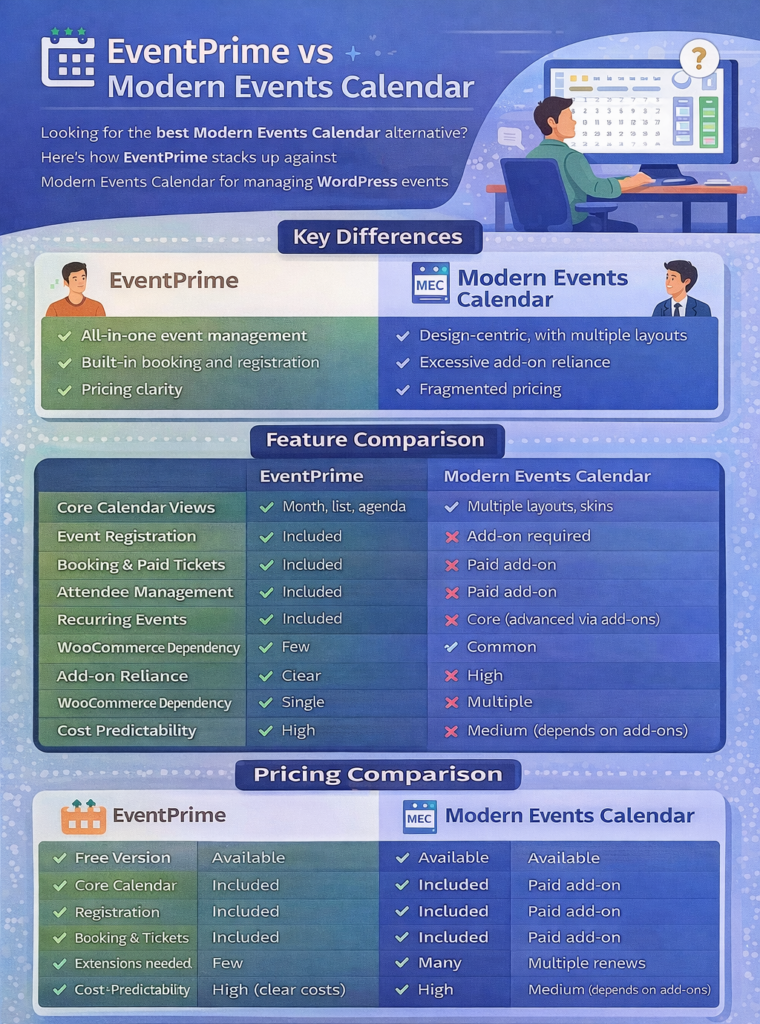
Feature Comparison: EventPrime vs Modern Events Calendar
| Feature | EventPrime | Modern Events Calendar |
|---|---|---|
| Event calendar views | Month, list, agenda | Multiple visual skins |
| Event registration | Built-in | Add-on required |
| Paid ticketing | Built-in | Add-on required |
| Attendee management | Built-in | Add-on required |
| Venues & organizers | Built-in | Add-on required |
| Recurring events | Core feature | Core (advanced via add-ons) |
| Event workflows | Structured | Fragmented |
| WooCommerce dependency | Optional | Common |
| Add-on reliance | Low | High |
| Pricing predictability | High | Medium to low |
This table explains why users searching for a Modern Events Calendar alternative often prioritize EventPrime when they need more than visual customization.
Event Registration and Booking
Modern Events Calendar does not treat registration and booking as core responsibilities. Instead, these features are introduced via extensions such as ticketing or booking add-ons. This approach works for simple use cases but increases complexity as requirements grow.
EventPrime includes event registration and booking natively. Event capacity, confirmations, and attendee data are handled within the same system.
For workshops, classes, conferences, and paid events, built-in booking significantly reduces dependency on third-party tools.
Attendee Management and Operational Control
Managing attendees is often where design-focused plugins struggle.
With Modern Events Calendar:
- Attendee data is typically tied to add-ons
- Management interfaces vary by extension
- Exporting or tracking attendees can involve multiple components
With EventPrime:
- Attendee lists are native
- Capacity limits and status tracking are part of the event workflow
- Event organizers can manage attendance without external tools
This difference matters for sites that run recurring or capacity-limited events.
Extension Ecosystem: A Deep Dive
Extensions play a central role in Modern Events Calendar.
Modern Events Calendar offers a large extension library covering:
- Booking
- Ticketing
- Frontend submissions
- Advanced schedules
- Integrations
While this provides flexibility, it also introduces challenges:
- Multiple licenses
- Compatibility management
- Rising total cost
- Complex upgrade paths
EventPrime follows a different approach. Core event workflows are included by default, and extensions are reserved for advanced or specialized use cases rather than essentials.
From a maintenance perspective, fewer extensions usually mean:
- Fewer update conflicts
- Lower risk of breakage
- Easier troubleshooting
Pricing Matrix: EventPrime vs Modern Events Calendar
| Pricing Aspect | EventPrime | Modern Events Calendar |
|---|---|---|
| Free version | Available | Available |
| Core calendar | Included | Included |
| Registration | Included | Paid add-on |
| Booking & tickets | Included | Paid add-on |
| Attendee management | Included | Paid add-on |
| Extensions needed for full setup | Few | Many |
| Pricing transparency | Clear | Complex |
| Renewal structure | Single | Multiple |
| Cost predictability | High | Medium |
Modern Events Calendar pricing often appears attractive initially. However, users frequently underestimate the total cost once essential extensions are added.
EventPrime’s pricing model makes it easier to understand upfront costs, especially for growing event operations.
Performance and Complexity
Modern Events Calendar’s heavy emphasis on layouts and frontend assets can impact performance, particularly on mobile devices or large event archives.
EventPrime prioritizes data structure and workflow consistency. While it still supports frontend display, it avoids unnecessary asset loading where possible.
For SEO-sensitive sites, performance stability becomes increasingly important.
Strengths and Limitations
Modern Events Calendar strengths:
- Extensive design options
- Large number of layouts
- Active extension ecosystem
Modern Events Calendar limitations:
- Heavy reliance on paid add-ons
- Fragmented workflows
- Increasing complexity over time
EventPrime strengths:
- All-in-one event management
- Native booking and attendee handling
- Clear workflows and pricing
EventPrime limitations:
- Fewer visual skins than MEC
- Requires understanding of event workflows
Being transparent about limitations helps users choose based on fit rather than marketing claims.
Ideal User Types
Modern Events Calendar is ideal for:
- Design-centric websites
- Event listings without registrations
- Users prioritizing visual layouts
EventPrime is ideal for:
- Event organizers
- Educational institutions
- Businesses running paid or free events
- Sites needing operational control
Understanding the user context is more important than comparing feature checklists.
Common Mistake When Choosing WordPress Calendar Plugins
Many users choose a WordPress event calendar plugin based on screenshots alone.
The more important question is:
What happens after someone clicks on an event?
If the answer involves multiple plugins, extensions, or manual work, the setup may not scale.
Why EventPrime Is a Strong Modern Events Calendar Alternative
Users who switch from Modern Events Calendar often cite:
- Extension overload
- Rising costs
- Difficulty managing attendees
- Desire for simpler workflows
EventPrime addresses these concerns by treating event management as a unified system rather than a collection of add-ons.
SEO and Structured Data Considerations
Event-based content benefits from proper schema implementation.
Google’s event structured data guidelines highlight the importance of accurate event information:
Plugins that manage event data cleanly make it easier to implement structured data correctly.
Final Verdict
Modern Events Calendar remains a strong option for design-focused event listings. However, as event requirements grow, its extension-heavy approach can introduce complexity and cost.
EventPrime offers a workflow-driven alternative that prioritizes registrations, bookings, and attendee management within a single, cohesive system.
For users searching for a Modern Events Calendar alternative that scales with real-world event operations, EventPrime is often the more practical long-term choice.