
A Deep Analysis on WordPress Popularity Using Google Trends and Keyword Research
For nearly two decades, WordPress has been synonymous with website creation. Powering blogs, business websites, ecommerce stores, and even government portals, it has long been perceived as the default choice for publishing on the web. However, in recent years, a recurring question has gained traction across developer forums, SaaS communities, and digital marketing circles:
Is WordPress popularity declining?
This article deliberately avoids the often-quoted WordPress market share debate. Market share is a lagging indicator and heavily influenced by legacy installs. Instead, we focus on interest, intent, and awareness, using two primary signals:
These two lenses together give us a much clearer picture of whether WordPress popularity declining is a valid concern—or simply a misunderstanding of how user behaviour has evolved.
Why We Are Not Using Market Share Data
Before diving in, it is important to clarify why WordPress market share alone is not enough.
WordPress market share measures:
- Existing websites
- Historical installations
- Long-term inertia
It does not measure:
- New developer interest
- Research intent
- Learning behavior
- Curiosity from first-time users
A CMS can maintain or even grow its WordPress market share while its popularity declines among new users. This distinction is critical.
That is why this article focuses on WordPress popularity declining as reflected through search behavior and trend data.
Analysis Overview
We analyzed:
- Google Trends – Worldwide
- Time range: 2004 to present
- Time range: Past 5 years
- Search type: Web Search
- Keyword analytics spreadsheets
- Branded queries related to WordPress
- Informational and commercial keywords
- Long-tail developer and beginner queries
Google Trends (2004–Present):
When we examine Google Trends from 2004 to the present, a clear pattern emerges.
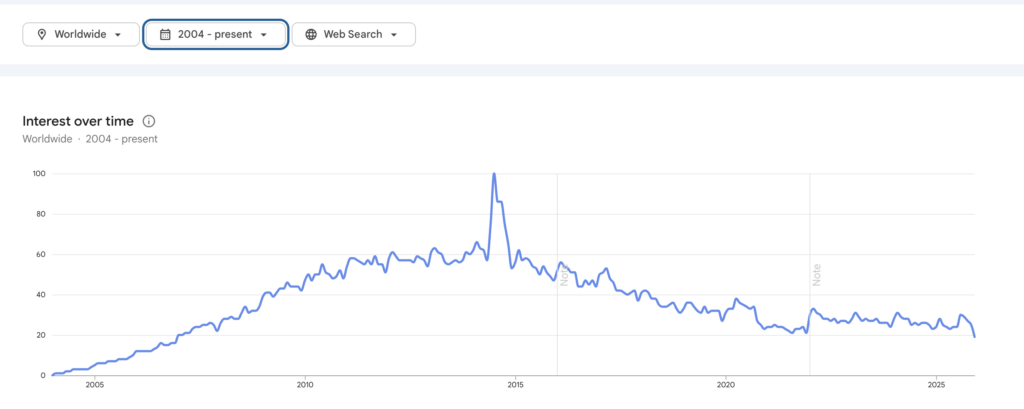
| Period | Approx. Trend Index | Direction | Key Insight |
|---|---|---|---|
| 2004–2006 | 1–5 | Rising | Early adoption phase |
| 2007–2009 | 15–35 | Rising | Blogging boom |
| 2010–2012 | 45–60 | Strong growth | Mainstream CMS adoption |
| 2013–2015 | 80–100 (Peak) | Peak | Highest global interest |
| 2016–2018 | 45–55 | Declining | Post-peak normalization |
| 2019–2021 | 30–40 | Declining | Competition & platform fatigue |
| 2022–2025 | 20–30 | Low & stable | Mature ecosystem phase |
Phase 1: Early Growth (2004–2010)
- WordPress begins near zero awareness
- Gradual and steady rise
- Adoption driven by bloggers and early publishers
- CMS competitors were limited and fragmented
During this period, WordPress popularity grew almost linearly.
Phase 2: Rapid Expansion and Peak Interest (2010–2015)
This is where WordPress popularity reached its global peak.
- Explosive growth in:
- “WordPress themes”
- “WordPress plugins”
- “How to build a WordPress website”
- Massive influx of freelancers, agencies, and DIY users
- Hosting companies aggressively promoted WordPress
The Google Trends graph clearly shows a sharp spike around 2014–2015, marking the highest point of search interest in WordPress history.
This was the golden era for:
- Developers
- Theme shops
- Plugin businesses
- Educational content creators
Phase 3: Gradual Decline (2016–Present)
After the peak, the trendline begins to slope downward.
This does not indicate collapse—but it does indicate something important:
WordPress popularity declining has been a slow, steady process, not a sudden drop.
Key observations from the image:
- Post-2015 interest never returned to peak levels
- Each year’s “highs” are lower than the previous cycle
- Interest stabilizes at a lower baseline
Despite this, WordPress market share remained strong—creating a disconnect between usage and interest.
Google Trends (Past 5 Years): A More Concerning Signal
The second image—the past 5 years worldwide—is arguably more revealing.
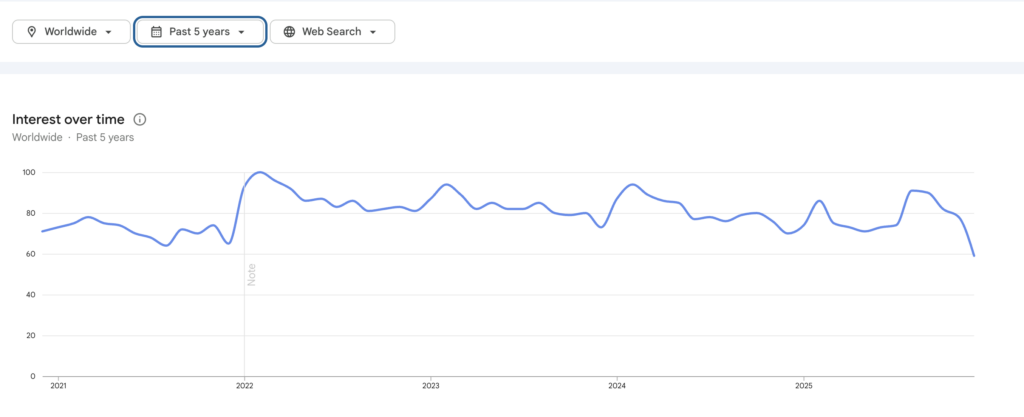
| Year | Avg Trend Index | YoY Change | Observation |
|---|---|---|---|
| 2021 | ~78 | — | Post-pandemic rebound |
| 2022 | ~82 | +5% | Short-term spike |
| 2023 | ~80 | -2% | Stabilization |
| 2024 | ~75 | -6% | Breach of prior support |
| 2025 | ~60–65 | -15% | Lowest point in 5 years |
What the Last 5 Years Show
- WordPress search interest fluctuates within a narrow band
- Recent periods show breaches below historical support levels
- The most recent dip is among the lowest points in the last five years
This supports the argument that WordPress popularity declining is not just historical—it is ongoing.
Important observations:
- The decline is not steep
- But it suggests fewer new users are actively researching WordPress
This matters deeply for:
- Plugin developers
- Theme businesses
- Educators
- Agencies targeting first-time site builders
Keyword Analytics: What People Are Searching Less (and More)
Keyword analysis reinforce what Google Trends suggests.
| Keyword Category | 2015–2018 | 2019–2022 | 2023–2025 | Trend |
|---|---|---|---|---|
| “What is WordPress” | High | Medium | Low | Declining |
| “How to use WordPress” | High | Medium | Low | Declining |
| “WordPress tutorial” | High | Medium | Low | Declining |
| “WordPress plugins” | Medium | Medium | Medium | Stable |
| “WordPress security” | Medium | High | High | Growing |
| “WordPress performance” | Medium | High | High | Growing |
Declining Keyword Categories
Across multiple datasets, we see reduced volume for:
- “What is WordPress”
- “How to use WordPress”
- “WordPress tutorial for beginners”
- “WordPress vs X” comparisons
These keywords traditionally signal new user entry into the ecosystem.
Their decline is a strong indicator of WordPress popularity declining at the discovery stage.
Stable or Resilient Keyword Categories
Not all signals are negative.
Keywords that remain relatively strong:
- “WordPress plugins”
- “WordPress security”
- “WordPress performance”
- “WordPress updates”
These searches come from existing users, reinforcing why WordPress market share remains high even as popularity signals soften.
Why WordPress Popularity Declining Does NOT Mean WordPress Is Dying
This distinction is crucial.
WordPress popularity declining does not mean:
- Websites are shutting down
- WordPress is losing relevance overnight
- Existing businesses should panic
Instead, it suggests:
- Fewer new users are entering via traditional search
- The learning and research journey has shifted
The AI Effect: A Major Blind Spot in Google Trends
One of the most important factors often ignored in these discussions is behavioral shift.
Research Is Moving Away From Google
Users increasingly:
- Ask ChatGPT instead of Googling “How to build a website”
- Use AI tools for setup, troubleshooting, and comparisons
- Skip traditional blog tutorials altogether
This has directly impacted Google Trends data.
So while WordPress popularity declining appears true in search data, part of this decline may be measurement distortion, not actual loss of interest.
WordPress Market Share vs WordPress Popularity: A Table
| Metric | Trend |
|---|---|
| WordPress market share | Stable to growing |
| New user search interest | Declining |
| Developer awareness | Stable |
| Beginner research | Declining |
| Brand maturity | Very high |
| Innovation perception | Mixed |
This explains why debates around WordPress popularity declining often become confusing.
What This Means for Plugin and Theme Developers
For businesses like ours, this data is especially relevant.
Key takeaways:
- Rely less on beginner discovery
- Focus more on:
- Existing WordPress users
- Power users
- Agencies
- Cross-promotion inside products becomes more valuable
- Education must adapt to AI-assisted workflows
A declining discovery funnel means retention and expansion matter more than ever.
Is WordPress Popularity Declining?
Based on:
- Google Trends (2004–present)
- Google Trends (past 5 years)
- Keyword analytics
- Behavioral shifts toward AI platforms
We can confidently say:
- Yes, WordPress popularity declining is visible in search and trend data
- No, this does not imply WordPress is losing relevance or market share
- User research behaviour has fundamentally changed
WordPress is transitioning from a growth-driven platform to a mature infrastructure layer of the web.
That transition naturally looks like decline when measured using old tools.
Note for Readers
If you are evaluating WordPress today:
- Do not rely solely on Google search trends
- Consider how AI, onboarding tools, and managed platforms reshape adoption
- Understand that WordPress market share and WordPress popularity declining can coexist
They are not contradictions—they are signals of maturity.
At EventPrime, we see this data as a positive signal. While overall WordPress popularity may be evolving, its strong ecosystem and stable WordPress market share reaffirm our decision to continue building EventPrime as a powerful, focused event plugin for serious use cases. We’d love to hear your thoughts—do you see these trends reflected in your own experience?
Questions, Support & Custom Solutions
- Need more details or can't find what you're looking for? Let us know how we can help! Contact our support team here.
- Looking for a tailor-made solution to meet your specific needs? Our dedicated customization team is here to help! Use this link to share your requirements with us, and we'll collaborate with you to bring your vision to life.