EventPrime vs Eventbrite
Eventbrite has become almost synonymous with online event ticketing. For many organizers, it is the first platform they encounter when they need to publish an event, sell tickets, and manage attendees. Its ease of use and large discovery ecosystem make it an attractive starting point.
However, as events evolve from one-off listings into ongoing programs, many organizers begin questioning whether a SaaS platform like Eventbrite is the right long-term foundation. This is usually when searches for an Eventbrite alternative begin—not because Eventbrite fails outright, but because its model no longer aligns with growing needs.
This article examines EventPrime and Eventbrite through a broader lens than features alone. It looks at ownership, control, cost structure, SEO impact, data portability, and how real users behave once events become central to their business or community.
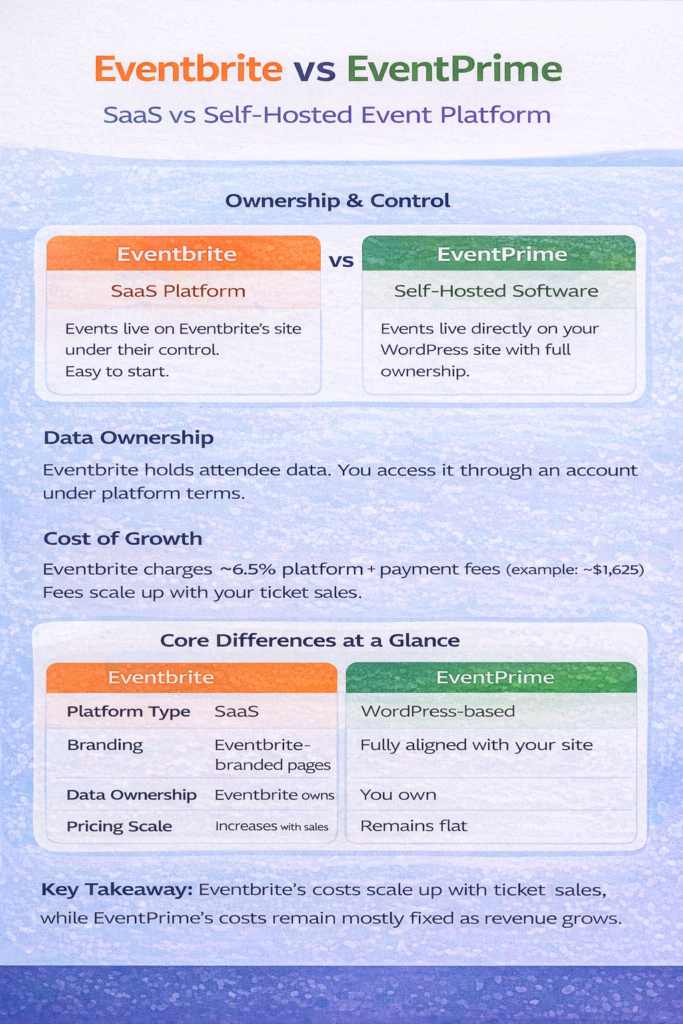
Approaches to Event Management
At a technical and philosophical level, Eventbrite and EventPrime are not direct equivalents.
Eventbrite is a hosted SaaS platform. Everything—events, tickets, attendee data, checkout flows—lives on Eventbrite’s infrastructure. You access it through an account, and your events exist within Eventbrite’s ecosystem.
EventPrime is self-hosted software built on WordPress. It becomes part of your website, using your hosting, your database, and your design system. In practical terms, this means your event system belongs to you in the same way your website does.
This distinction matters more than any single feature comparison, and it is often the deciding factor for organizations moving away from Eventbrite.
Why Eventbrite Works Well at the Start
Eventbrite’s popularity is not accidental. For new organizers, it solves several problems immediately. You do not need a website, technical knowledge, or hosting. You can create an event, accept payments, and publish a ticket page within minutes.
Its built-in discovery tools also play a role. Many organizers report that their early events benefit from Eventbrite’s marketplace exposure, especially for public or entertainment-focused events. This visibility is one of Eventbrite’s strongest advantages and explains why it remains widely used.
However, the same support forums and user discussions that praise Eventbrite’s convenience often highlight growing friction once events become recurring or brand-driven.
Where the SaaS Model Starts to Show Friction
As events scale, organizers tend to notice a pattern. Costs rise as ticket sales increase. Branding feels constrained. SEO benefits accrue to Eventbrite’s domain rather than their own. Attendee data lives behind platform rules rather than within their own systems.
These concerns appear frequently in long-running Eventbrite user discussions and reviews. Organizers managing training programs, conferences, or community events often describe feeling “locked in” once they have built an audience on the platform.
This is not unique to Eventbrite. It is a common characteristic of SaaS platforms designed for rapid onboarding rather than long-term ownership.
EventPrime’s Role as a Self-Hosted Alternative
EventPrime approaches event management as software rather than a service. Installed on WordPress, it allows organizations to treat events as first-class content on their own site.
From a practical standpoint, this means events inherit the same advantages as any other WordPress content. URLs live on your domain. Design aligns with your theme. SEO authority accumulates to your site rather than being shared with a third-party platform.
For organizations that already rely on WordPress for publishing, memberships, or commerce, this integration often feels more natural than maintaining a separate SaaS presence.
Data Ownership and Long-Term Trust
One of the most cited reasons users seek an Eventbrite alternative is data ownership.
With Eventbrite, attendee and transaction data is accessible, but it exists within Eventbrite’s ecosystem and terms. While exports are possible, usage is still framed by the platform’s policies. Several organizers have expressed concern in support discussions about relying too heavily on a single external platform for customer relationships.
EventPrime, by contrast, stores all event and attendee data in the site’s WordPress database. This allows organizations to integrate events with CRM systems, email marketing tools, or analytics platforms without intermediary restrictions.
From a trust and compliance standpoint, this control is particularly relevant for organizations operating in regulated environments or handling sensitive attendee information.
Branding, UX, and SEO Implications
Eventbrite provides functional branding options, but the experience remains recognizably Eventbrite. Event pages typically live on eventbrite.com subdomains or URLs that clearly indicate platform ownership.
Over time, this affects brand perception and SEO. Event pages indexed by search engines primarily strengthen Eventbrite’s authority, not the organizer’s website.
EventPrime events live entirely on the organizer’s domain. As events accumulate, they contribute to the site’s topical authority. This is especially valuable for organizations running ongoing programs, where event pages become evergreen content rather than temporary listings.
SEO professionals frequently point out that this compounding effect is one of the strongest arguments for self-hosted event systems.
Pricing Models and the Cost of Growth
Eventbrite’s pricing is straightforward at first glance, but its cost structure scales with success. Platform fees and payment processing charges apply per ticket, meaning popular events become more expensive to run over time.
Eventbrite’s pricing overview:
https://www.eventbrite.com/pricing
For some organizers, this is acceptable. For others—especially those running frequent or high-volume events—it becomes a recurring concern raised in user reviews and community discussions.
EventPrime follows a software licensing model. Costs are predictable and largely independent of ticket volume. Payment processing fees depend on the gateway you choose, not on a platform markup.
This difference often becomes decisive once events move from experimentation to operation.
Pricing Comparison (Conceptual)
| Aspect | EventPrime | Eventbrite |
|---|---|---|
| Platform type | Self-hosted software | SaaS platform |
| Per-ticket platform fees | No | Yes |
| Payment gateway choice | Organizer’s choice | Eventbrite-managed |
| Cost scalability | Flat | Increases with sales |
| Long-term predictability | High | Variable |
How Costs Scale: Eventbrite vs EventPrime
Cost is one of the most misunderstood aspects when comparing Eventbrite with a self-hosted alternative like EventPrime. At a glance, Eventbrite often appears inexpensive or even “free to start.” The difference only becomes clear when events begin generating meaningful revenue.
To understand how costs scale, it helps to look at a realistic scenario rather than abstract percentages.
Example Event Scenario
Assume an organizer runs a paid event with the following setup:
- Ticket price: $50
- Tickets sold: 500
- Total gross revenue: $25,000
This is not an unusually large event. Many training programs, workshops, and small conferences operate comfortably at this scale.
Cost Scaling on Eventbrite
Eventbrite typically charges a combination of platform fees and payment processing fees. While exact fees vary by region and plan, a commonly cited structure includes:
- Eventbrite service fee (percentage per ticket)
- Payment processing fee (percentage + fixed amount per transaction)
For illustration, assume a combined average of approximately 6.5% per ticket (platform + processing). This is a conservative estimate based on publicly discussed pricing.
On $25,000 in ticket revenue:
- Estimated total fees: $1,625
- Net revenue after fees: $23,375
The key point is not the exact number, but the behavior of the cost. As ticket sales increase, fees increase proportionally. A $50,000 event would roughly double the fees. A $100,000 event would multiply them again.
This scaling model means that success directly increases platform costs. Many organizers mention in support discussions and reviews that this becomes noticeable once events are no longer experimental but operational.
Cost Scaling on EventPrime
EventPrime operates under a fundamentally different model.
EventPrime itself does not charge a per-ticket or percentage-based platform fee. Instead, costs are limited to:
- The EventPrime license (fixed, predictable)
- Payment gateway fees (charged by Stripe, PayPal, or another provider)
Using the same example:
- Gross revenue: $25,000
- Typical payment gateway fee: ~2.9% + fixed transaction fees
For simplicity, assume an average of around 3% total processing cost.
- Estimated total fees: $750
- Net revenue after fees: $24,250
The important distinction is that EventPrime does not add an additional platform margin on top of payment processing. Costs scale only according to the payment provider, not according to the software you use.
Marketing Capabilities and a Hybrid Approach
Eventbrite’s marketing reach is one of its strongest assets. Discovery features, email tools, and social integrations help organizers reach audiences beyond their own networks.
EventPrime does not attempt to replicate this marketplace. Instead, it offers an Eventbrite extension that allows organizers to connect their self-hosted event system with Eventbrite’s promotional ecosystem.
This hybrid approach reflects a pattern seen among experienced organizers. They retain ownership of their event infrastructure while selectively using Eventbrite’s reach when it makes sense. This strategy allows them to benefit from Eventbrite’s strengths without surrendering control.
Open Source as a Strategic Advantage
EventPrime is built on WordPress, which brings the benefits of open-source software. Transparency, extensibility, and community scrutiny contribute to long-term stability.
WordPress plugin development principles:
https://developer.wordpress.org/plugins/
Eventbrite, as a proprietary platform, evolves according to internal priorities. While this is not inherently negative, it does mean users adapt to the platform rather than shaping it.
Organizations that value adaptability often cite open-source foundations as a key reason for moving away from SaaS platforms.
Support Patterns and Real-World Usage
A review of public support channels reveals a consistent pattern. Eventbrite users frequently ask how to customize workflows, integrate deeply with their websites, or reduce platform fees. These questions often lead to workarounds rather than native solutions.
EventPrime users, on the other hand, tend to ask how to extend or integrate the plugin within WordPress. This reflects a difference in mindset: platform usage versus system ownership.
Neither is inherently wrong, but they suit different stages of growth.
Strengths and Limitations in Context
Eventbrite remains an excellent solution for quick setup, public discovery, and minimal technical involvement. It is particularly effective for organizers without existing websites or technical resources.
EventPrime excels where ownership, branding, SEO, and long-term scalability matter. It requires initial setup, but rewards that investment with autonomy and control.
Acknowledging these trade-offs builds credibility and helps users choose based on fit rather than marketing promises.
Ideal Use Cases Revisited
Eventbrite is best suited for organizers who prioritize speed, reach, and minimal setup, especially for one-off or public events.
EventPrime is better suited for organizations building event programs, communities, or recurring offerings where events are integral to their digital presence.
This distinction appears repeatedly in user feedback and migration stories across WordPress and event-management communities.
Final Perspective
The choice between Eventbrite and EventPrime is not about which platform is “better” in isolation. It is about whether you want to rent an event platform or own an event system.
Eventbrite offers convenience and reach. EventPrime offers control, ownership, and long-term value.
For organizations that see events as part of their core digital strategy, self-hosted solutions like EventPrime increasingly represent the more sustainable path.